


Demonstrating value: how to prepare the numbers you share
How to share a financial plan that demonstrates to an investor the value that you are going to create with their funds.
“Can we have your financial plan?”
When speaking to investors during a funding round, you are asking them to back your business and, importantly, back you as an individual. Investors need to know how you are planning to use their funds to build future value, from which you both seek to benefit. Part of how they assess this is to ask to see and discuss your financial plan.
What investors want to see
Investors won’t spend lots of time trying to figure out the answer themselves… so how can you clearly and quickly demonstrate the value to them and move discussions beyond that first meeting?
You can do this by presenting a clear, accessible financial plan that clearly reflects:
- The business goals that you are aiming for
- The milestones you need to achieve on the way
- The investments that you need to make to drive your key metrics to a point that demonstrates an increased value
- How you expect those key metrics will move over time
- The funding that you need to get you there
What investors want to see
When reading a financial plan - investors want to understand how what you have explained in your business plan translates to:
- Revenue growth
- Profitability timeline
- Cash runway
- How sensitive the plan is to certain inputs
A quick alignment on terminology
Business plan: The narrative plan for how you will start, run and grow your business
Financial model: A spreadsheet version of your business plan that uses a set of numerical inputs, assumptions and formulas to generate numerical outputs.
Once you have built a model, you can fix down a set of numbers to become a financial plan
Financial plan: A version of your financial model that has an output set of fixed numbers that you intend to strive for; your current plan given what you currently know, your plans and what you expect to happen.
In order to complete a financial plan, you first need to build a financial model (a tool) to populate with inputs and generate outputs
What do investors need in a financial model?
If you want your best chance of moving beyond that first meeting you need to convey the information you want to get across clearly and effectively.
Just the same as your deck, your financial model should be clearly structured and formatted before you share it with an investor. I have seen many financial model spreadsheets that have been shared with VCs that are impenetrable due to poor structuring and formatting. Investors want to learn something about your business from this document so it needs to be thoughtfully presented.
Some of the most common structuring issues I see are:
- Too many tabs
- Hard-coded numbers with no commentary on how they have been calculated
- Lack of sign-posting to the key inputs that are driving the modelled revenue plan
investors need:
- Clear formatting
- Summary page of tables and charts
- Key drivers set out
- Informed using actual data (as much as possible)
- Aligned with key strategic events in the roadmap
- Clearly linked to £ funding request
Investors don’t need:
- Something they need to study for hours; overly complicated formulas or hundreds of tabs
- Unexplained assumptions
- Something you can’t explain to them
- Something produced in expensive software
What do investors need from you?
Founders who can talk an investor through their financial plan and explain how the model works will have a higher chance of making it past the first meeting. If you can walk an investor through your financial model then you are demonstrating to them that:
- you have an informed overview of YOUR business and all the drivers (levers) that you have to play with
- you understand the interconnectedness of the market, your product, your customer, you sales strategy, your marketing strategy, your pricing strategy and the impact on your achievable profitability, timelines and cash flow needs
- you are someone who can be trusted to use the investor’s funds to create value
Why let investors have all the fun - I have worked with many founders who, through building a financial model, realise that this is a tool that they can use when planning for growth. Founders I work with use their financial model to understand things about their business such as:
- Potential growth rates if they pull different levers
- When they may become profitable, under different scenarios
- What their cash runway is
- How sensitive their plan is to certain Inputs
Presenting clarity to investors
“How do these numbers match up to the business plan?”
You can add a simple, clear narrative back into your spreadsheet to signpost key points to an investor.
As well as making sure you clearly label rows and columns, you can also use the ‘Insert Notes’ feature to add commentary to a cell in a spreadsheet or simply add a sentence in the next cell explaining the logic or assumptions you have used.
I have also seen founders detail a brief product timeline at the bottom of their spreadsheet showing the key product development activities and milestones alongside the projected spend and cash position (especially useful in a pre-revenue business which is still developing it’s product).
Demonstrate a clear direction
Discussions with Investors revolve around a shared interest in the future potential of your business. They want to understand where you see it going. To demonstrate a direction to them you can present your story around the goals and key milestones using the following structure:
- where you are today
- where you want to get to after this fundraise
- long term goals
In doing so make sure to clearly articulate these key details:
Examples of Milestones:
- Launch a new product
- Get a prototype out
- Optimise a key metric
- Prove GTM strategy
- Bridge to larger fundraise
- Speed up growth
- Make key hire
- Goals - What you are driving towards; business goals and investment goals (exit goals?)
- Milestones - what are the steps along to way to achieving your goals
- Activities - what activities will you need to do to achieve each milestone
- Indicative timescales - what are the timings of the above activities and milestones and how do they fit into each funding round
Demonstrate a clear use of funds
Investors want to be confident that when they hand over their cash you are going to use their funds to build future value from which you will both benefit.
Make sure the investors can clearly see what you are going to do with this funding round in terms of:
- Product,
- Revenue growth and
- Cash position
and how your activities will improve the key metrics in each of these areas.
Top tip
Leave yourself plenty of time to get there - you don’t want to spend all your time raising money.
The balancing act -
“Maintain a cash runway that is long enough to create the value needed for a “successful” next raise”
If something doesn’t add-up, an investor won’t spend lots of time trying to figure out why, they will push your deck to the side and pick up the next.
Keep you financial plan in-sync with all your other planning and pitching documents.
Demonstrating value to investors
Investors perceive value as a demonstrable path to an increased valuation. You need to show investors how you are planning to drive up value.
Know your numbers
Your business will have key metrics that you will be tracking that demonstrate to you that you are growing. You need to tell the story of what you are going to do and how those activities are going to drive up the performance of your key metrics.
Your financial plan is your tool for guiding discussions around value creation by looking at the planned performance of your metrics. Your financial plan should:
- set out the current performance of your key metrics
- show how you expect each metric to change over time through various value-driving activities.
Those founders who can clearly demonstrate the improvement of a key metric through a series of activities will grab an investors attention.
Example
Is there a key customer-type that you want to prove you can sell to because they will drive the most future value?
- Measure sales to that customer type and set out the activities you are going to do to win those deals
- Do you need to build a certain feature that they need? Do you need a different marketing channel? What is the cost of building that feature and when will it be live? What is the cost of using that new marketing channel and what is the conversion time from spend to demo?
Example key metrics🔗
There are hundreds of metrics out there.
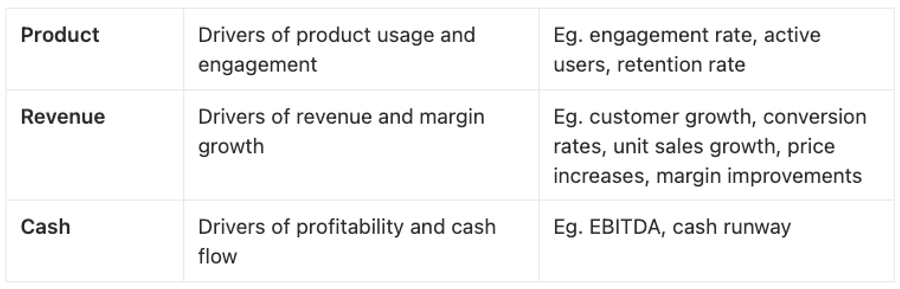
It is helpful to consider them in metric groups and make sure that you are presenting metrics across key areas: Product, Revenue and Cash.
Here are some examples for each of these metric types:
Conclusion
Clearly and quickly demonstrate how you intend to use Investor’s funds to deliver value and move discussions beyond that first meeting by presenting a clear, accessible financial plan that clearly reflects:
- the business goals that you are aiming for
- the milestones you need to achieve on the way
- the investments that you need to make to drive your key metrics to a point that demonstrates an increased value
- how you expect those key metrics will move over time
- the funding that you need to get you there.
Financial plan checklist
[ ] Clearly linked to business goals, milestones and activities
[ ] Includes metrics that will measure our progress towards value creation
[ ] Articulates where we are now and where we want to be in terms of our key metrics
[ ] Illustrates (calculates) our current funding gap - the amount we are raising